Block and tackle and chain falls
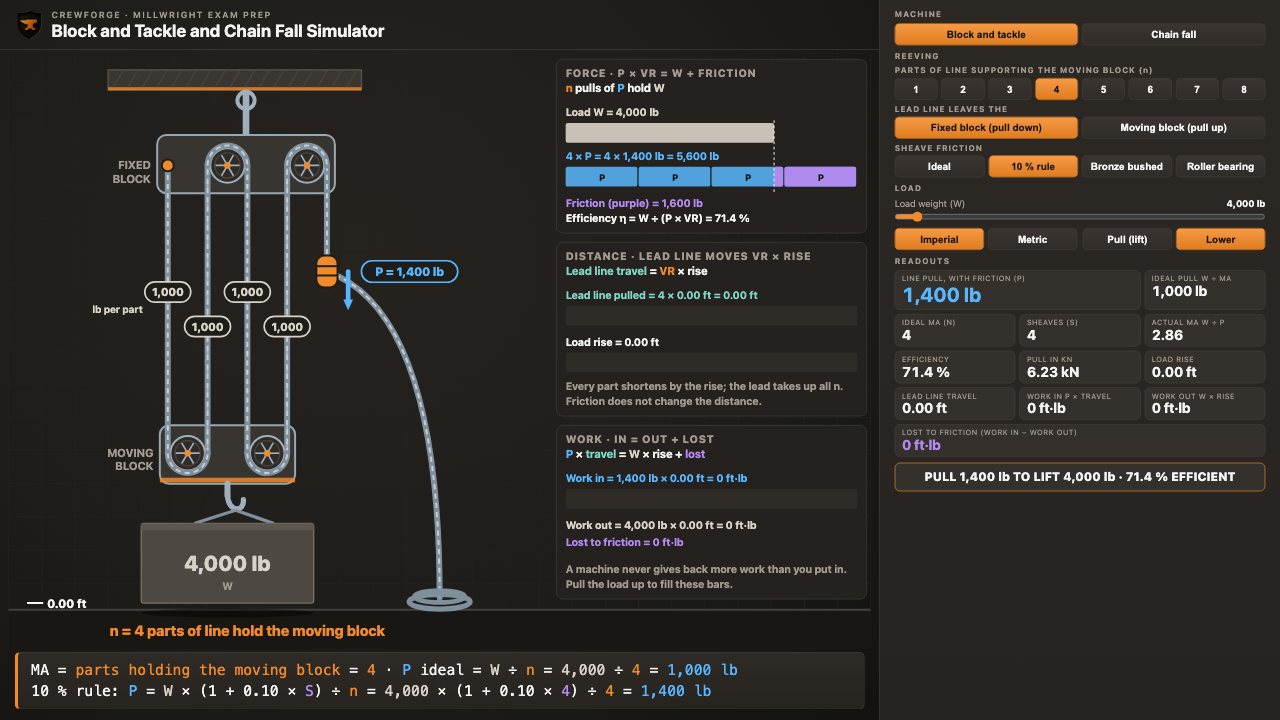
Reeve a block and tackle with up to eight parts of line, choose the sheave friction, and pull. Watch the tension in every part, how far the lead line travels, and how much work is lost. Then try a geared or differential chain fall.
Open full screen · Exam preparation only: always check the block and hoist rating, the manufacturer's data and your lift plan.
What this calculator works out
The pull needed on the lead line of a block and tackle with 1 to 8 parts of line, its mechanical advantage, how far you pull for each foot or metre of lift, and the work lost to sheave friction. It also covers geared and differential chain falls.
The formula in words
The ideal mechanical advantage equals the number of parts of line holding the moving block, so the ideal pull is the load divided by the parts. A common allowance for friction (the 10 % rule) adds 10 % of the load for every sheave the rope runs over. The lead line travels the number of parts times the lift.
Worked example
- Imperial: 4,000 lb on 4 parts, lead line off the fixed block (4 sheaves): ideal pull 4,000 ÷ 4 = 1,000 lb. With the 10 % rule, 4,000 × 1.4 ÷ 4 = 1,400 lb. Lifting 2 ft takes 4 × 2 = 8 ft of lead line.
- Metric: 2,000 kg on the same 4-part reeving: ideal pull 500 kg. With the 10 % rule, 2,000 × 1.4 ÷ 4 = 700 kg, about 6.86 kN. Lifting 1 m takes 4 m of lead line.
Watch the simulators explained on the CrewForge YouTube channel, or work through the free sample lesson to see how a full CrewForge lesson is built.
Want the full lesson?
Every simulator in the program comes with a full lesson, worked exam questions, a scored challenge, a printable textbook chapter and unit tests. See a complete one free.
More free simulators
Rigging, hydraulics, shaft alignment and pumps. The same simulators used in the lessons and the videos.