
Sling angles and load angle factors
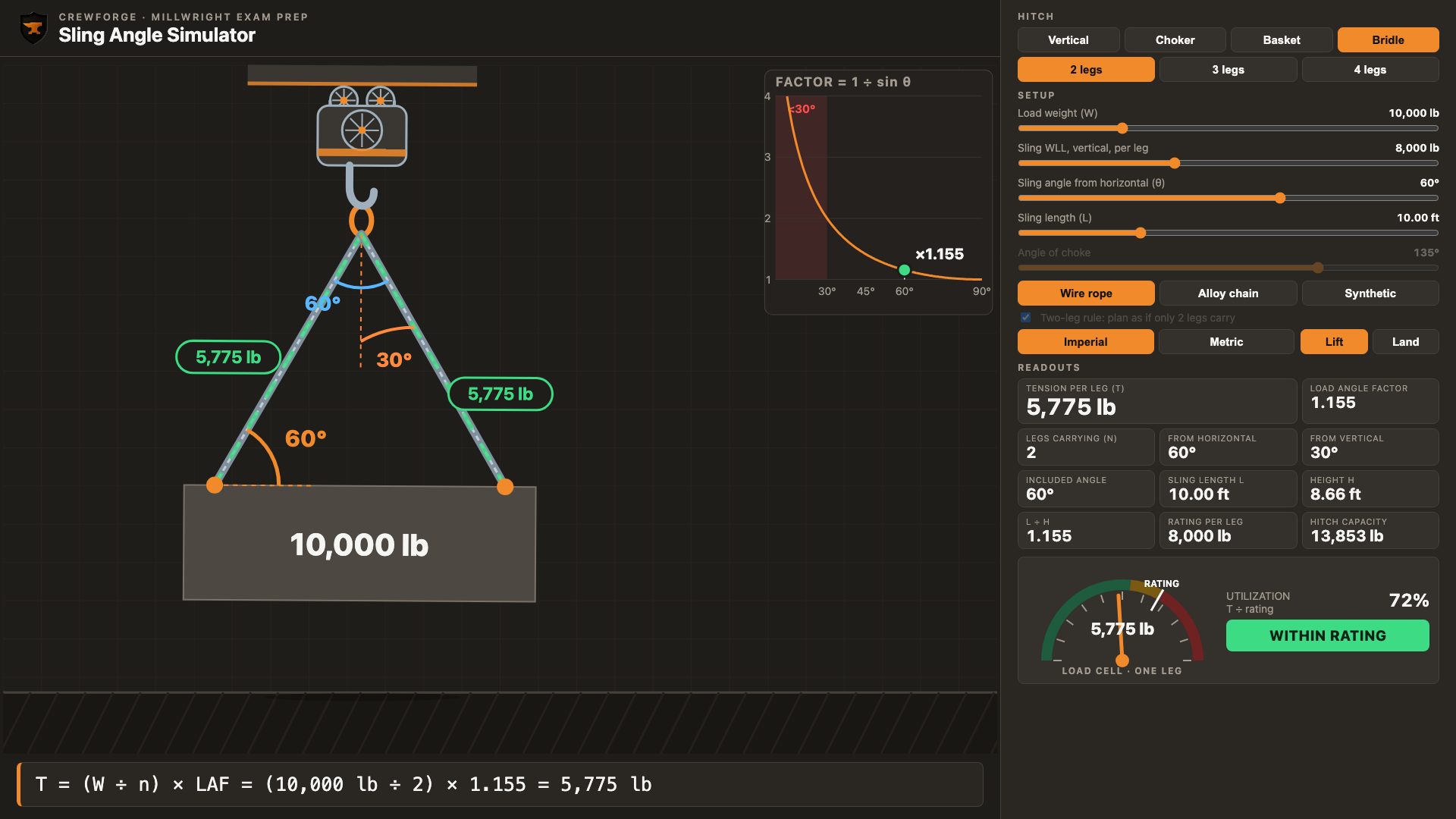
Pick a hitch, set the load and the sling angle, and watch the tension in each leg. Try 60°, then 45°, then 30°, and see why lowering the sling angle is one of the most-tested traps on the Red Seal exam.
Open full screen · Exam preparation only: always check the sling tag, the manufacturer's charts and your lift plan.
What this calculator works out
The tension in each sling leg for a two-, three- or four-leg bridle, and the rated capacity of chokers and baskets, from the load weight and the sling angle, in pounds or kilograms.
The formula in words
Tension in each leg equals the load divided by the number of legs, times the load angle factor. The load angle factor is 1 divided by the sine of the sling angle, measured from the horizontal: 1.155 at 60°, 1.414 at 45° and 2.000 at 30°. For three- and four-leg bridles, count only two legs as carrying the load.
Worked example
- Imperial: a 10,000 lb load on a two-leg bridle at 60°: 10,000 ÷ 2 = 5,000 lb, times 1.155 = 5,775 lb in each leg.
- Metric: a 4,000 kg load on a two-leg bridle at 60°: 4,000 ÷ 2 = 2,000 kg, times 1.155 = 2,310 kg in each leg (about 22.7 kN).
The free sling angles lesson works through 17 examples with this simulator, and the episode is on the CrewForge YouTube channel.
Want the full lesson?
The Level 1 rigging unit adds full lessons, worked exam questions, a scored challenge, a printable textbook chapter and unit tests.
Watch it explained
See the simulator walk through sling angles, the load angle factor and seven exam-style questions on our YouTube channel.