
Chain falls: geared hoist and differential block
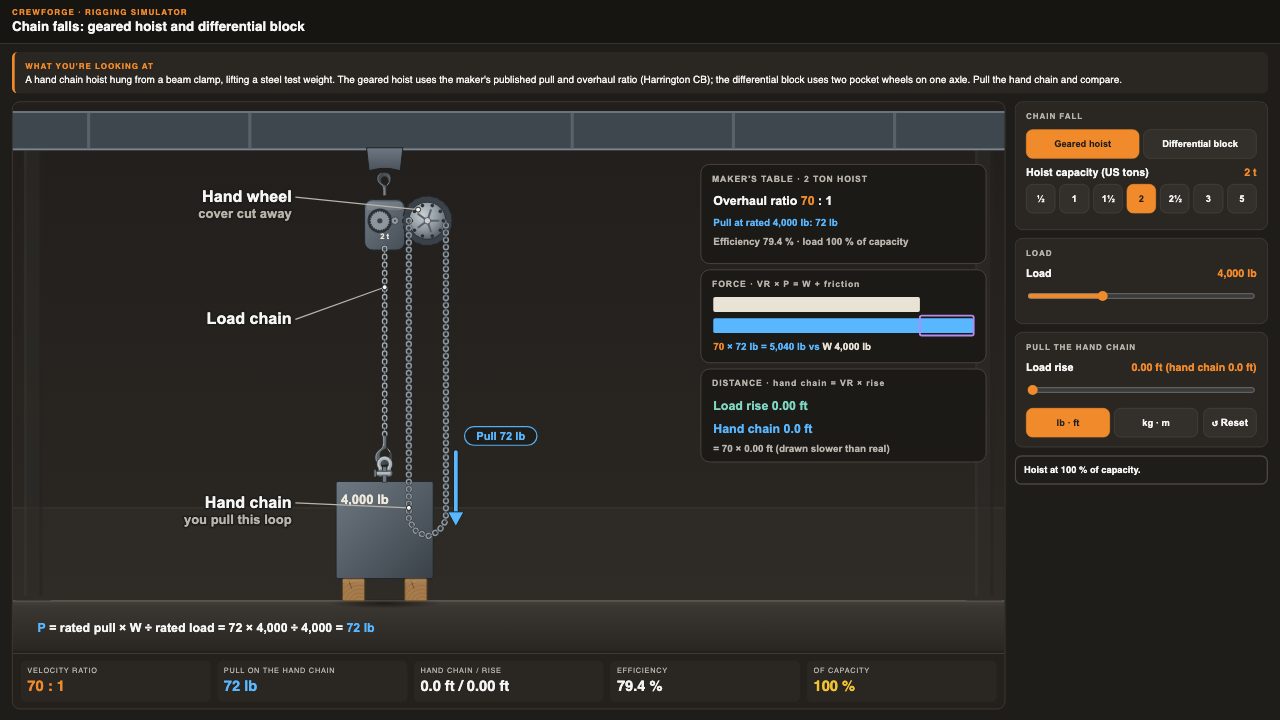
A hand chain hoist hung from a beam clamp, lifting a steel test weight. Pick the hoist size and the load, pull the hand chain, and compare a geared hoist with an old differential block: how hard you pull, how much chain you pull, and where the effort goes.
Open full screen · Exam preparation only: always check the hoist's rating, the manufacturer's data and your lift plan.
What this simulator works out
The pull on the hand chain for a geared hoist from ½ to 5 tons, scaled from the maker's published pull at rated load, the hand chain you pull for a given lift, and the efficiency. Switch to a differential block to see its velocity ratio from the two pocket wheels.
The formula in words
For a geared hoist, the pull is the maker's pull at rated load times the load, divided by the rated load. The hand chain travel is the overhaul ratio times the lift. Efficiency is the load divided by the ratio times the pull.
Worked example
- Imperial: a 2 ton geared hoist (rated 4,000 lb) with a listed pull of 72 lb at rated load and an overhaul ratio of 70 : 1, lifting 4,000 lb: pull 72 lb. Lifting 1 ft takes 70 ft of hand chain. Efficiency = 4,000 ÷ (70 × 72) = 79.4 %.
- Half the load: the same hoist lifting 2,000 lb needs 72 × 2,000 ÷ 4,000 = 36 lb of pull, and still 70 ft of hand chain for each foot of lift.
The block and tackle simulator covers parts of line and sheave friction, and the free Block and tackle lesson teaches both, one page at a time.
Learn it step by step
The free Chain hoists lesson: the pull, the ratio, lever hoists and the check before you lift. Narrated, with practice questions.
More free simulators
Slings, load weight and CG, block and tackle, cranes, moving loads and wire rope, plus hydraulics, alignment and pumps.