
Load weight and centre of gravity
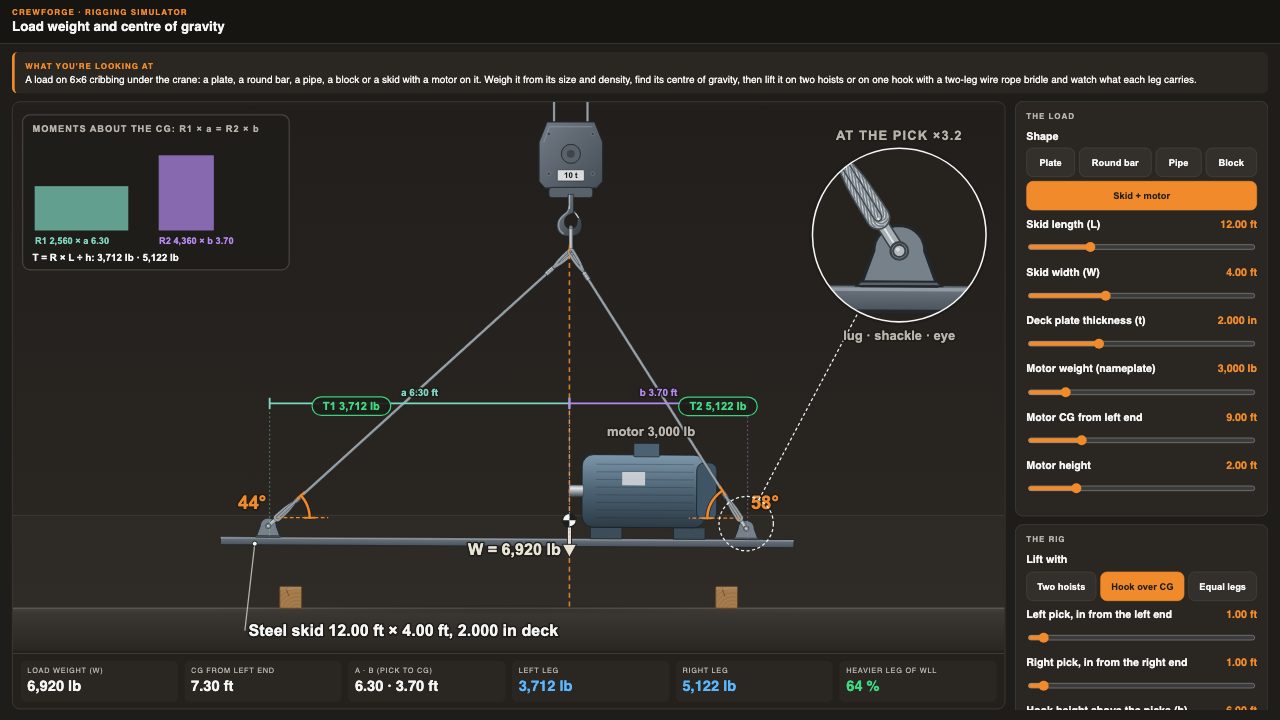
A load on cribbing under the crane: a plate, a round bar, a pipe, a block or a skid with a motor on it. Weigh it from its size, find its centre of gravity, then lift it on two hoists or on one hook with a two-leg bridle and watch what each leg carries.
Open full screen · Exam preparation only: always use the maker's or the shipping weight when you have it, and follow your lift plan.
What this simulator works out
The weight of a plate, bar, pipe, block or skid from its size and the density of steel, the combined centre of gravity of a skid with a motor on it, and the share each hoist or bridle leg carries.
The formula in words
Weight is volume times density (steel is about 0.2836 lb per cubic inch). The combined centre of gravity is each part's weight times its distance from one end, added up, divided by the total weight. Each pick point carries the total weight times the distance from the other pick point to the CG, divided by the distance between the picks.
Worked example
- Imperial: a steel skid 12 ft × 4 ft with a 2 in deck weighs 144 × 48 × 2 × 0.2836 = 3,920 lb, with its CG at 6 ft. Add a 3,000 lb motor at 9 ft: total 6,920 lb, CG = (3,920 × 6 + 3,000 × 9) ÷ 6,920 = 7.30 ft from the left end. With picks 1 ft in from each end, the left pick carries 6,920 × 3.70 ÷ 10.00 = 2,560 lb and the right pick 4,360 lb.
See how a lesson works
The free sample lesson, Hitches: narrated simulator pages, practice questions and a printable summary sheet. No sign-up.
More free simulators
Slings, block and tackle, cranes, hoists, moving loads and wire rope, plus hydraulics, alignment and pumps.