
Wire rope inspection: count the broken wires
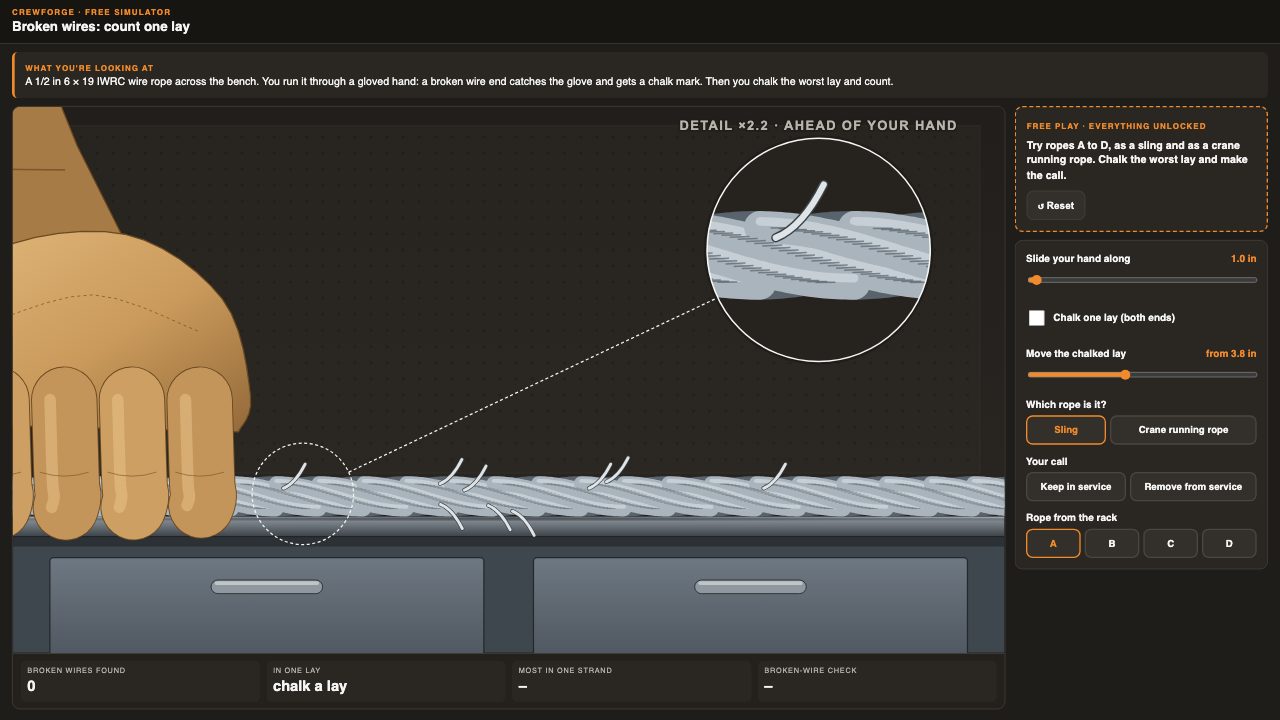
A 1/2 in 6 × 19 IWRC wire rope across the bench. Run your gloved hand along it: a broken wire end catches the glove and gets a chalk mark. Chalk off one rope lay, slide it over the worst spot, count, and make the call. Four ropes on the rack, used as a sling or as a crane's running rope.
Open full screen · Exam preparation only: on the job, follow your province's regulation, the manufacturer's data and your site's inspection procedure.
The limits it uses
- Wire rope sling: remove it at 10 broken wires in one lay, or 5 in one strand in one lay. B.C. (s. 15.30) and Alberta (s. 297) send slings to ASME B30.9, a licensed standard; these figures are the published US OSHA rule (29 CFR 1910.184), used because the standard can't be quoted.
- Crane running rope: tighter, because it runs over sheaves all day: 6 broken wires in one lay, or 3 in one strand in one lay (for example B.C. OHS Regulation s. 15.25 and Alberta OHS Code s. 306; check your province).
How to count
Find the breaks with a gloved hand, never a bare one. Mark one rope lay (the length it takes one strand to go once around the rope), slide it to where the breaks bunch up, and count the breaks in that lay and in the worst strand.
See how a lesson works
The free sample lesson, Hitches: narrated simulator pages, practice questions and a printable summary sheet. No sign-up.
More free simulators
Slings, load weight and CG, block and tackle, cranes, hoists and moving loads, plus hydraulics, alignment and pumps.