Jacking one end of a machine
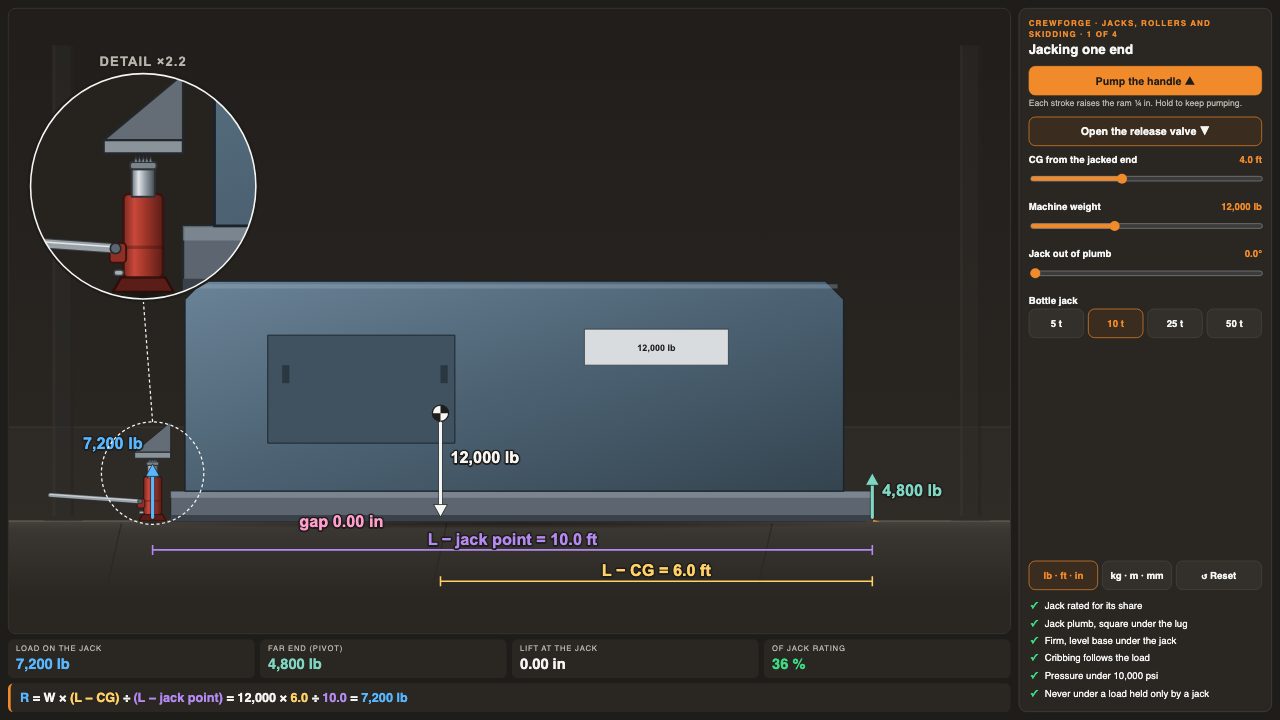
A machine on a skid, a bottle jack under one end. Move the centre of gravity, change the weight, pick the jack, then pump the handle and watch the end come up. The far end stays on the floor as the pivot, and the jack carries only its share of the weight.
Open full screen · Exam preparation only: always check the jack's rating, the manufacturer's data and your work plan. Never work under a load held only by a jack.
What this simulator works out
The load on the jack and on the far end (the pivot) from the machine's weight and where its centre of gravity sits, the lift at the jack, and the load as a percentage of the jack's rating. Push the jack out of plumb, or go past its rating, and see what goes wrong.
The formula in words
Take moments about the far end. The load on the jack equals the weight times the distance from the far end to the centre of gravity, divided by the distance from the far end to the jack.
Worked example
- Imperial: a 12,000 lb machine, jack 10 ft from the far end, centre of gravity 6 ft from the far end (4 ft from the jacked end): 12,000 × 6 ÷ 10 = 7,200 lb on the jack. The far end carries 12,000 − 7,200 = 4,800 lb. On a 10 ton (20,000 lb) jack, that is 36 % of its rating.
Also try the skidding and rolling simulator.
See how a lesson works
The free sample lesson, Hitches: narrated simulator pages, practice questions and a printable summary sheet. No sign-up.
More free simulators
Slings, load weight and CG, block and tackle, cranes, hoists and wire rope, plus hydraulics, alignment and pumps.