
Skidding and rolling a load
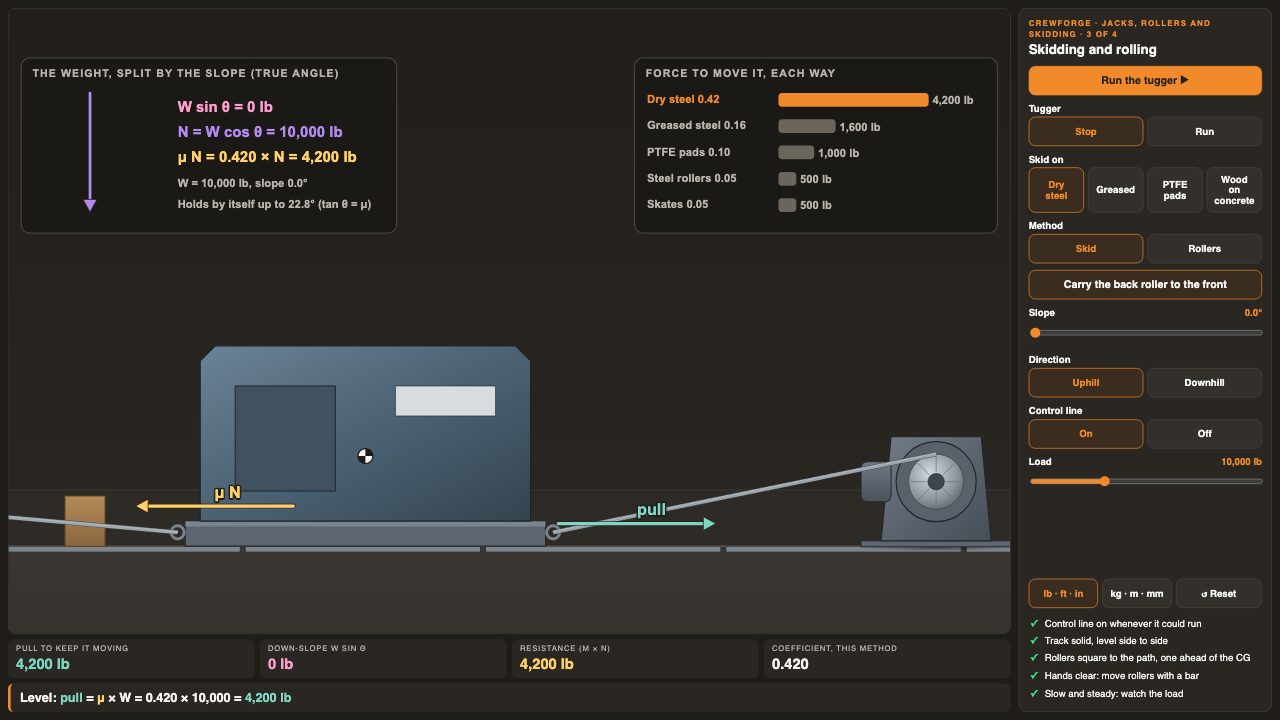
A machine on a skid, pulled by a tugger. Pick what it slides on, or put it on rollers, set the slope and the load, and run the tugger. The bars compare the pull for every method, and the load shows why a control line matters on a slope.
Open full screen · Exam preparation only: friction values change with the surface. Always check the manufacturer's data and your work plan.
What this simulator works out
The pull to keep the load moving on dry steel, greased steel, PTFE pads, wood on concrete, steel rollers or skates, on the level or on a slope, uphill or downhill. It splits the weight into the part pressing on the surface and the part pulling down the slope.
The formula in words
On the level, the pull equals the coefficient of friction times the weight. On a slope, the friction comes from the part of the weight pressing on the surface (weight times the cosine of the slope), and the part pulling down the slope (weight times the sine) is added going uphill.
Worked example
- Imperial: a 10,000 lb load skidded on dry steel (coefficient 0.42) on the level: 0.42 × 10,000 = 4,200 lb of pull. On greased steel (0.16): 1,600 lb. On steel rollers (0.05): 500 lb.
Also try the jacking simulator.
See how a lesson works
The free sample lesson, Hitches: narrated simulator pages, practice questions and a printable summary sheet. No sign-up.
More free simulators
Slings, load weight and CG, block and tackle, cranes, hoists and wire rope, plus hydraulics, alignment and pumps.